AI Workforce Design™
Formalizing Workforce Architecture for
the Intelligence Age
Artificial Intelligence is no longer a technology issue — it is a workforce issue. Organizations are rapidly deploying AI to perform work traditionally done by people, yet no formal academic discipline exists to teach leaders how to design, govern, and operate AI-based labor systems.
The Missing Discipline
Technology shifted
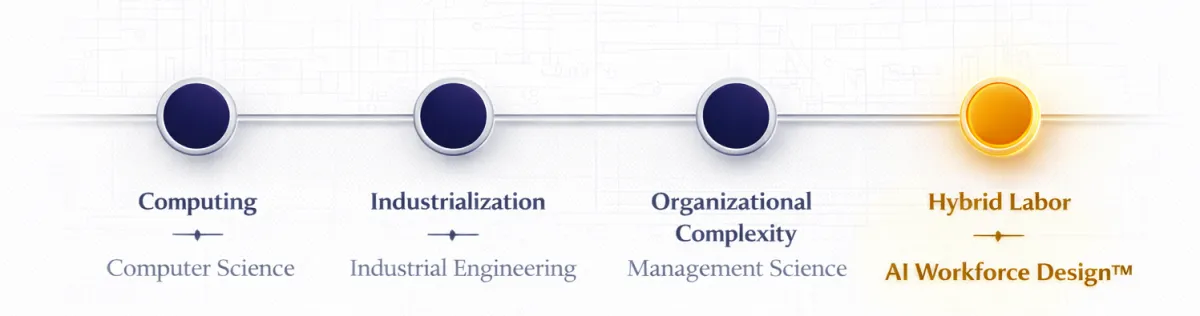
The nature of productive labor has fundamentally shifted from purely human execution to systems increasingly mediated by computational intelligence. Work is no longer defined solely by human capability, but by the integration of silicon-based agents into core operational functions. This structural transformation demands a corresponding evolution in how labor systems are designed.
Organizational Adoption
Artificial intelligence has been adopted at a pace that exceeds the development of formal design standards governing its integration into the workforce. Organizations are deploying AI as an operational asset without a structured methodology for human–machine role allocation. As a result, implementation frequently precedes architectural clarity.
No formal Discipline
Despite the emergence of hybrid labor environments, no recognized academic or professional discipline formally governs the design of integrated human–AI work systems. Existing fields address technology, management, or human resources in isolation, but none establish a unified framework for engineering silicon–carbon collaboration. This absence constitutes a structural gap at the field level.

WHAT IS AI WORKFORCE DESIGN™
AI Workforce Design (AIWD) is the engineering discipline dedicated to architecting integrated human–AI labor systems. It treats artificial intelligence not as software, but as productive labor—assigning it defined roles, responsibilities, performance criteria, and governance constraints within the organizational structure. AIWD ensures that when machines perform work, they are designed, supervised, and measured with the same rigor applied to human workforce planning.
Rather than automating tasks in isolation, AI Workforce Design decomposes work at the task level, allocates responsibilities between silicon and carbon based on capability and risk, and establishes formal operating models for collaboration. It defines how AI agents are structured, how humans retain accountability, and how hybrid labor systems are governed, optimized, and scaled.
In short, AI Workforce Design provides the missing architectural standard for the Intelligence Age—transforming AI from an experimental tool into a formally engineered component of the modern workforce.
What It Is:
It is architecture
It is governance
It is accountability
It is ethics
What It Is Not:
Prompt engineering or model tuning
Traditional HR workforce planning
Experimentation without governance
Disciplines Are Formalized by Universities
Universities that introduce AI Workforce Design™ curriculums:
Anchor a new field
Establish certification legitimacy
Prepare graduates for emerging demand
Shape standards rather than follow them
Why Organizations Will Require Certified Professionals
Measurable Allocation
Governance Accountibility
Intelligence Capacity
Workforce Elevation
Audit Readiness
Architectural Discipline
FUTURE PROOF
Software is moving at light speed. Worforce design is standing still. This is the Intelligence Gap. We Bridge it.
The Three Pillars

Standardized Methodology: The Silicon-Carbon Ratio (SCR)
Professional Certification: The Certified AIWD Engineer (CAWE) designation
Ethical Equilibrium: A "Glass Box" approach to autonomous labor.
Defining the Standard
Pathways

THE CATEGORY
Standards. Curriculum. Certification.
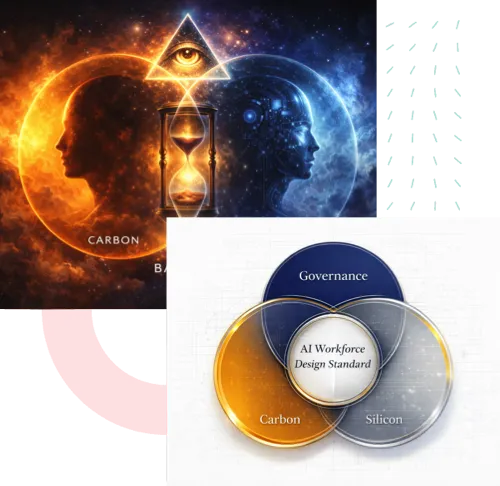
Most AI companies focus on the Silicon (the software). Most HR firms focus on the Carbon (the people). We occupy the high-value "glue" between them.
Curriculum Framework
We are the bridge between Human Capital Management (HCM) and AI Systems Engineering.
Certification Pathway
We are a Metasystem—we don't build the AI, and we don't hire the humans; we design the logic by which they work together.
Professional Registry
We are a Metasystem—we don't build the AI, and we don't hire the humans; we design the logic by which they work together.
Why Universities Partner With Us
Overcome Your Biggest Challenges
The "Curriculum Lag" Anxiety
It is terrifying to think by the time a 4-year degree is finished, the skills taught are obsolete. You may be feeling the "fragmented response" of having a few AI elective courses but no cohesive, foundational framework.
The Credibility Gap
90% of faculty believe AI is weakening critical thinking. Universities are struggling to prove that their graduates are "AI-Ready" when 58% of students feel unprepared for an AI-integrated workforce.
The "Ad-Hoc" Struggle:
Many institutions are stuck in a "Policy Loop"—constantly updating cheating and plagiarism guidelines instead of building an AI-infused pedagogy that elevates human reasoning.
Why Corporations Will Demand This Skillset
The transition to an integrated labor force is not an option; it is an inevitability.
Organizations that fail to architect this transition today are effectively designing their own obsolescence. Without an AI Workforce Design Engineer representing
their interests, the only voice they hear is from the vendor.
The Productivity Paradox
They’ve spent millions on AI tools but haven't seen the "bottom-line" ROI because they are "sprinkling" AI onto legacy org charts. They have the software but lack the Design.
The Governance Nightmare
Leaders are losing sleep over "Control Failures"—scenarios where an AI assistant accidentally leaks executive compensation data or makes a legal decision without a "Carbon Gatekeeper."
The "Skill Crisis"
They face a massive IT skills shortage (projected to cost $5.5 trillion globally by 2026). They are desperate for a standard that doesn't just "train" workers but re-architects roles so their best people move "Up-Stack."
YourSchool




Frequently Asked Questions
Thought Leadership
How does AIWD differ from standard Ai Implementation or "Digital Transformation"?
Most "Digital Transformation" focuses on the tool—installing software and training users. AIWD focuses on the architecture. We treat AI not as a tool, but as a new labor force. While implementation firms ask, "How do we use this software?" AIWD Engineers ask, "How do we re-engineer the organization’s Silicon-Carbon Ratio (SCR) to maximize total intelligence capacity?" We design the structure; they just install the pipes.
Is the goal of AIWD to eventually achieve a 100% Silicon workforce?
Absolutely not. That is a failure of design. A 100% Silicon workforce creates a "Strategic Single-Point-of-Failure." Our methodology is built on the Human Delta. We believe that as Silicon intelligence scales, the value of "Carbon-Essential" traits—like Ambiguity Resolution and Ethical Intuition—becomes exponentially more valuable. Our goal is to move humans "Up-Stack" so they are orchestrating the intelligence, not competing with it.
Why does AIWD license its standards to Universities instead of just consulting with corporations directly?
Because a new labor category requires Institutional Legitimacy, not just a sales pitch. By partnering with leading Universities and Executive Education programs, we ensure that AIWD is a rigorous, peer-reviewed academic standard. This allows us to maintain a global Registry of Truth—ensuring that a Certified AIWD Engineer (CAWE) in London meets the exact same high-rigor standards as one in New York. We are building the profession, not just a business.
What is "Ethical Equilibrium," and why is it a technical requirement in your designs?
In our category, ethics isn't a "nice-to-have" or a PR statement; it is a safety protocol. "Ethical Equilibrium" is our design standard for Glass Box Governance. We mandate that every autonomous Silicon loop must terminate at a Carbon Ethical Gate. This prevents "Black Box" failures where AI decisions drift away from human values. If a design doesn't have Equilibrium, it doesn't get the AIWD Seal of Excellence.
Can we apply AIWD standards to our existing legacy workforce, or do we need to start from scratch?
Our Baseline Intelligence Audit (BIA) is specifically designed to transition legacy organizations. We don't advocate for "rip and replace." Instead, we use Granular Task Decomposition (GTD) to identify exactly where your current human talent is being wasted on "Silicon-ready" tasks. We then provide the roadmap to re-allocate that human energy toward high-context, high-revenue innovation. We aren't replacing your workforce; we are architecting its evolution.
Organizational Design for the Ai Age.
Links
Home
About Us
Contact Us
Blog
Legal
Legal
Terms of Use
Term & Condition
Privacy Policy
Newsletter
Join our community to stay updated on the latest courses, exclusive content, and learning resources. Subscribe now and take the next step in your educational journey!